Bitcoin and Ethereum at Risk as CLARITY Act Stalls Over Trump Ethics – What Price Action to Expect Next

Bitcoin, Ethereum, and crypto in general are having a bad week. Bitcoin has pulled back to around $76K after failing to hold recent highs, while Ethereum is also drifting lower (now below $2.3K) with fading momentum.
One of the main narratives behind this slowdown is the growing uncertainty around the CLARITY Act in the United States. What looked like a major step forward for crypto regulation is now facing serious political resistance.
With midterm elections approaching, neither side wants to give ground. The result is gridlock, and markets don’t like uncertainty
CLARITY Act Hits a Wall – Ethics Demands Stall Progress
The CLARITY Act is hitting a massive wall in the Senate. Democrats are reportedly withholding the seven key votes needed for passage, insisting on strict ethics rules aimed at the Trump family’s large crypto exposure. The midterm elections are approaching, and the future of U.S. crypto regulation is now a high‑stakes game of chicken.
No ethics deal means no CLARITY Act. Polymarket odds have continued to decline, now sitting at 44% – down from over 80% earlier this year.

Source: Polymarket
The bill was supposed to provide clear rules for digital assets, splitting oversight between the SEC and CFTC. But the ethics dispute has become a political football. Republicans may refuse to include restrictions that single out Trump. Democrats may refuse to vote without them.
The result is a standoff that could kill the bill for this session. If the CLARITY Act fails, regulatory uncertainty will persist, and institutional capital may stay on the sidelines.
Related news: Cardano’s Hoskinson Clashes With Clarity Act
Bitcoin Price Analysis
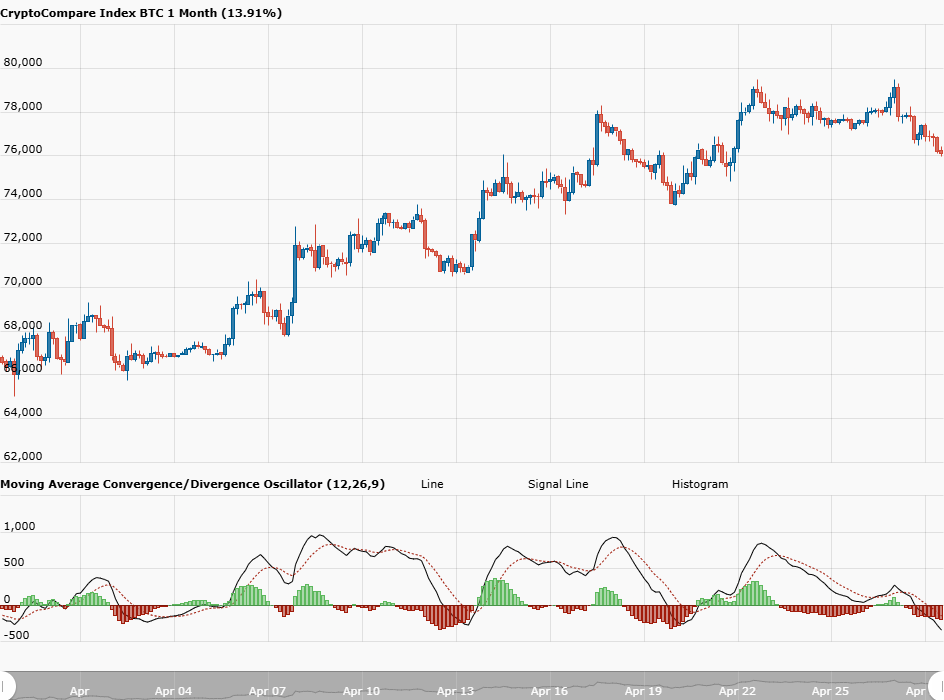
Bitcoin had a strong run earlier in the month, climbing steadily from the mid-$60K range up toward the high $70Ks. That move showed clear strength, with consistent higher highs and strong bullish momentum.
However, the latest part of the chart tells a different story. The BTC price has started to stall near the $78K–$79K range, followed by a gradual pullback toward $76K. This kind of behavior often signals exhaustion after a strong move.
Source: CryptoCompare.com
Looking at the MACD, momentum has clearly changed. The histogram has turned red, and the MACD line is crossing below the signal line. This points to weakening bullish momentum and a possible short-term correction phase.
At the same time, the pullback is not aggressive. Price is still holding above key support levels from earlier in the rally. This means that while momentum is cooling, the overall structure is not broken. For now, it looks more like consolidation than a full trend reversal.
Ethereum Price Analysis
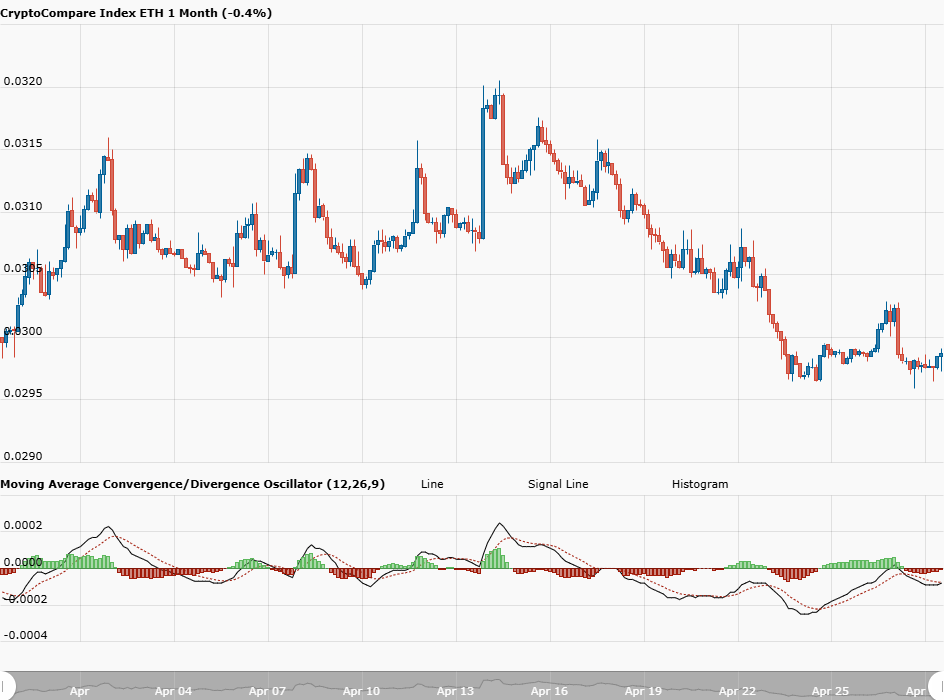
Ethereum has been much more sideways compared to Bitcoin. The chart shows a choppy range, with price moving between roughly 0.029 and 0.032 (BTC pair), without a clear breakout in either direction.
There were a few sharp spikes upward, but they were quickly sold into. This shows a lack of sustained buying pressure. Each attempt to push higher has been met with resistance.
Source: CryptoCompare.com
The MACD confirms this indecision. Momentum has been flipping back and forth, with no strong trend forming. The histogram moves between green and red frequently, which usually signals a ranging market.
Toward the end of the chart, there is a slight downward drift. Momentum is leaning bearish, but not aggressively. Ethereum is not collapsing, but it is also not showing strong leadership right now. It’s waiting for a clearer catalyst.
Our Take: Does the CLARITY Act Really Change the Trend?
In our view, a CLARITY Act failure would hurt altcoins more than Bitcoin and Ethereum. BTC and ETH already have regulatory clarity as digital commodities (ETFs are live). They do not need the Clarity Act to survive. The bill’s main beneficiaries are smaller altcoins like ADA, SOL, and XRP that still face security designation risks.
Bitcoin and Ethereum may see short‑term volatility on news headlines, but their institutional adoption is already underway. A prolonged delay or failure could keep the broader market range‑bound, but it is unlikely to trigger a crash. The bigger risk is for altcoins that were hoping for regulatory safe harbor.
For BTC and ETH, the focus remains on macro conditions and ETF flows.
In simple terms, the CLARITY Act matters, but it is not the only driver. The bigger trend for Bitcoin and Ethereum is still shaped by the wider market, not just one bill.
Other AxiomFinity's Crypto News for You
Frequently Asked Questions
1. What is the CLARITY Act in crypto?
The CLARITY Act is a proposed U.S. law that defines which digital assets are securities or commodities, assigning regulatory authority to either the SEC or CFTC to end the current jurisdictional uncertainty. It also aims to strengthen consumer protections, simplify registration for exchanges, and improve tax reporting for digital assets.
2. Why does Coinbase not like the CLARITY Act?
Coinbase has repeatedly opposed provisions in the bill that would restrict crypto platforms from offering rewards or yield on stablecoin holdings, which is a high-margin part of its business through its partnership with USDC issuer Circle. The exchange views these restrictions as anti-competitive banking protections that would damage its rewards model.
Related Articles
An XRP community member admitted feeling a growing gap between Ripple’s enterprise success and XRP’s price action. Lawye
Hedera’s institutional RWA partners include TOKO, Zoniqx, Bank of Australia, Lloyds, EMTECH, Dovu, Archax, and RedSwan.
In a wide‑ranging interview on The Crypto Coin Show, Charles Hoskinson criticized the Clarity Act’s legislative process,
South Korea's internet‑only bank KBank has entered a strategic partnership with Ripple to test on‑chain cross‑border rem