Clarity Act Timeline Delayed: 3 Altcoins That Could Crash If the Bill Dies (Including ADA)

The Clarity Act is at a critical juncture. Senate Banking Committee members are preoccupied with Kevin Warsh’s nomination hearing to replace Fed Chair Jerome Powell. After that, they have until Friday to notice a markup if they want to hold a vote the week of April 27.
But mounting pressure from banks (unhappy with stablecoin yield restrictions) could push a markup to the second week of May, after the Senate recess.
If the bill dies or is delayed indefinitely, three altcoins are especially vulnerable. Here is why.
Clarity Act Timeline – What’s Happening This Week
Early this week, the Senate Banking Committee will focus on Kevin Warsh’s nomination hearing. Warsh, a wealthy nominee with over $100 million in assets and significant crypto exposure, takes the hot seat Tuesday.
After that, the committee has until Friday to notice a markup. If they miss that window, the vote could slip to the second week of May. Banks are lobbying hard against the current stablecoin yield compromise. The North Carolina Bankers Association is urging members to call Senator Tillis’s office. Other banking groups are reaching out to additional committee members.
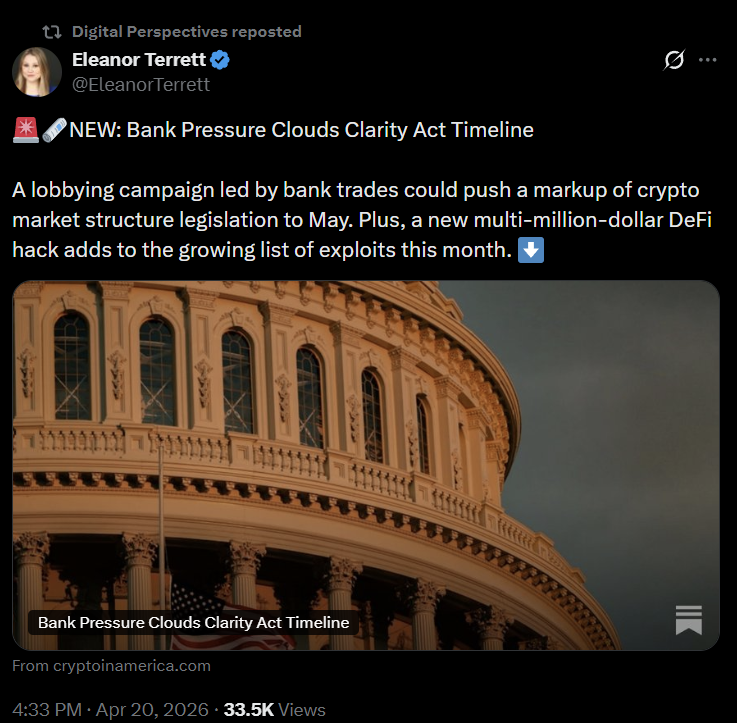
Source: X/@EleanorTerrett
Patrick Witt, Executive Director of the White House Crypto Council, called further lobbying “motivated by nothing other than greed or ignorance.” Tillis floated a “crypto palooza” – an in‑person meeting between bank and crypto experts – but that would add time. Yield aside, issues like ethics and DeFi provisions remain unresolved.
The question is not if the Clarity Act will pass, but when. A delay is one thing. A complete collapse is another.
3 Altcoins That Could Crash If the Clarity Act Dies
Cardano (ADA) – Most Exposed to SEC Overreach
Cardano’s founder Charles Hoskinson has repeatedly warned that the Act’s death – or even its passage – fails to protect DeFi, prediction markets, and stablecoin yields. Without clear rules, ADA remains vulnerable to SEC overreach. The research‑heavy ecosystem relies on U.S. regulatory clarity for developer inflows and exchange listings.
If the bill dies, stalled innovation could push ADA below $0.20 from current levels near $0.24. Hoskinson himself noted post‑Trump that a lack of clarity could trigger a 40‑50% market crash. Offshore business flight would hit ADA’s enterprise focus hardest, as no commodity protections shield its proof‑of‑stake model from security claims.
Our take: ADA is the most exposed of the three. Its price has already underperformed, and a failed Clarity Act would likely accelerate the decline toward $0.15-$0.20.
Read also: Cardano Price Forecast: Bulls Must Defend $0.24
Avalanche (AVAX) – Institutional Pause and Stalled Rulemaking
AVAX is already a CFTC‑designated “digital commodity,” but that status is not enough. The ecosystem is anticipating spot ETFs and institutional deals – including a $240 billion real‑world asset (RWA) pipeline. Without the Clarity Act, rulemaking stalls.
That keeps AVAX “stuck” near $9. Regulatory paralysis delays compliance upgrades and adoption, unwinding hype‑driven gains. A 30‑50% drop is possible as leveraged positions exit and key supports fail. Stablecoin yield restrictions would also tank DeFi TVL on Avalanche subnets.
Our take: AVAX is less vulnerable than ADA but still at risk. Institutional investors will wait on the sidelines until rules are clear. Expect $6‑$7 if the bill dies.
Solana (SOL) – Retail‑Heavy and Yield Sensitive
Solana’s explosive growth ties directly to over $17 billion in stablecoins and a vibrant DeFi ecosystem. The market has priced in Clarity Act‑driven ETF listings and institutional adoption – with some calling for $2,500. But yield bans and delays would crush issuers like Circle (which is down 18% already).
ChatGPT models predict the SOL price could crash to $40‑$80 on failure. Retail‑heavy SOL amplifies sentiment dumps; it currently trades near $83. CFTC commodity status is insufficient without full rules. A 40%+ crash from liquidity crunches and ETF delays is realistic.
Our take: SOL crashes hardest in a bearish scenario due to retail volatility. A drop to $50‑$60 is plausible within weeks if the Clarity Act collapses.
Overall, all three altcoins face market‑wide hits if the Clarity Act dies. Stablecoin yield bans would erode TVL across DeFi. DeFi liability fears would deter developers. Without clear rules, offshore exodus accelerates. SOL would crash hardest (retail volatility), AVAX next (institutional pause), and ADA the most (direct SEC exposure).
XRP would also be affected – read our weekly XRP price outlook for a full story of how the Clarity Act delay and other factors could impact Ripple's token.
Short‑term, 20‑50% drops are possible – especially because we are already in a bear market.
Frequently Asked Questions
1. Will the CLARITY Act pass in 2026?
Polymarket odds have dropped to around 58%, as Senate Banking Committee Chairman Tim Scott cited several unresolved issues that need weeks to work out before a vote. A final decision hinges on whether a markup is scheduled by this Friday for a vote the week of April 27th; otherwise, the bill could slip to May.
2. How will the CLARITY Act affect XRP?
It would codify XRP's digital commodity classification into permanent federal law, shifting its primary oversight to the CFTC and removing the final vestige of regulatory risk that has deterred institutional investment. Without it, XRP's commodity status remains only an opinion, which could keep the price stuck in its current range.
3. Will the CLARITY Act boost crypto prices?
Yes. JPMorgan analysts believe approval could serve as a positive catalyst for crypto markets, as a clear regulatory framework would give large asset managers and pension funds the compliance cover needed to increase allocations. However, a delay or failure would keep sidelined capital parked and could pressure altcoin prices further.
4. What will the CLARITY Act do?
It would split oversight of digital assets between the CFTC and the SEC, classifying tokens as either digital commodities or securities. Major tokens that already have spot ETFs listed before Jan. 1, 2026, including XRP, and Solana, would be grandfathered in as commodities.
Related Articles
Mr. Pool argues Bitcoin's 45% crash is not a bear market but a controlled demolition before the US government fills its
XRP monthly RSI has dropped to a deep oversold zone – only the 4th time in 13 years. Previous three resets marked major
Solana vote batching dropped validator breakeven from 7,200 SOL to 929 SOL – an 87% reduction. Small validators went fro
Strategy just deposited 411 BTC into Coinbase Prime. Polymarket odds of MicroStrategy selling BTC by Dec 31 just hit 84%