Bittensor (TAO) Called "Economically Bankrupt" – Token Holders Pay for Subnets, Get Zero Revenue

Crypto analyst Justin Brons posted a thread on X today (April 19) that has created a big debate, especially in the TAO community. He called Bittensor a "crypto-ponzi" and "unsustainable nonsense." His core argument: TAO has no utility or product-market fit.
The network prints $328 million worth of new tokens annually, yet generates only $15 million in annual revenue. Subsidies from holders pay for subnets, creating an economically bankrupt design.
The thread has hundreds of comments. Many from the TAO community defend the project. They argue Brons ignores the long-term vision, the value of decentralized AI, and the fact that Bittensor is still early. But some of his numbers and critiques are worth examining.
Justin Brons' Case Against Bittensor – Ponzinomics and Extraction
Brons argues that token inflation gives users the illusion of low cost. In reality, creating AI models in a decentralized way is far more expensive than centralized alternatives. Subnets are not created as competitive products, he says. They exist simply to extract as much value from TAO investors as possible.
He cites Pine Analytics data. Unsubsidized inference on the Chutes subnet would cost up to 3.5 times as much as centralized competitors like Deepseek or TogetherAI. Token holders pay for these subnets through inflation, yet none of the revenue flows back to them. Subnet operators keep 100% of the revenue plus 18% of emissions. Brons calls this a borderline scam – extremely profitable for subnet operators, but setting up token investors for extreme loss when the system collapses.
He also points out that TAO has a 21 million supply limit, which might appeal to ignorant token investors. But he claims this implies the network will collapse, as it is fundamentally unsustainable, just like Bitcoin – though that comparison is controversial.
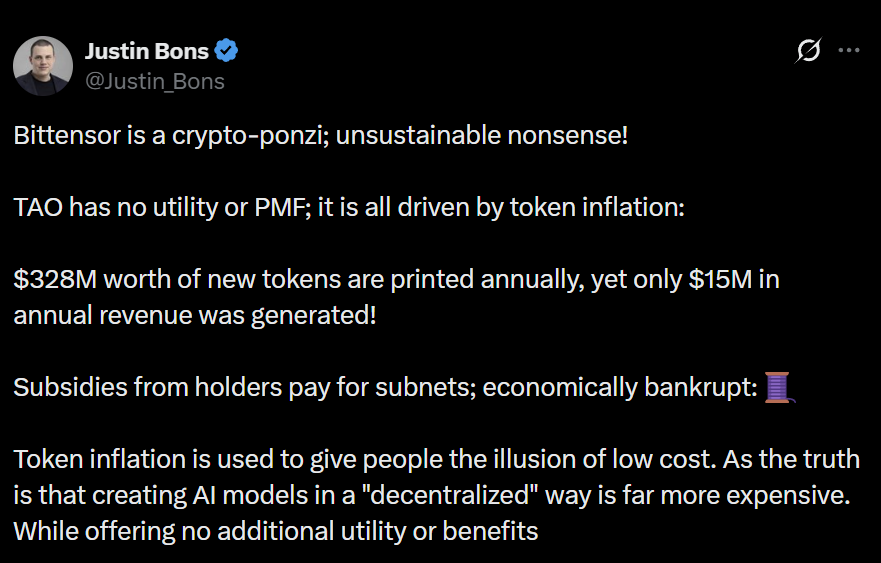
Source: X/@Justin_Bons
Brons goes deeper into inefficiency. Decentralized computing requires verification and replication. In a trustless environment, work must be replicated multiple times, introducing extreme inefficiencies. For simple transactions, that is fine. But for large computing tasks like AI training, it becomes a deal breaker. He notes that 41% of rewards go to "validators" whose sole job is to verify that work is legitimate – adding massive overhead.
He concludes that there is no legitimate incentive for any centralized organization to use a more expensive, less efficient decentralized AI network. The size of subnets is capped by how many people can be fooled into the scheme, nowhere near what centralized AI companies achieve today.
Read also: Crypto News Today: RAVE Plunges 94% as Exchanges Probe Insider Trading – XRP ETFs Hit $1.5B
Our TAO Take – Engagement Farming or Valid Critique?
Brons' thread is aggressive. He calls Bittensor "product theatre" and says crypto deserves better than half-baked ideas. The TAO community has pushed back hard, arguing that he ignores the network's progress, the upcoming upgrades, and the fact that decentralized AI is a long-term bet, not a quarterly earnings report.
It is possible Brons tweeted this to generate engagement. Negative threads on popular projects often go viral. And his tone is inflammatory, not academic. But that does not automatically make him wrong.
The numbers he presents are worth taking seriously. $328 million in annual inflation versus $15 million in revenue is a massive gap. Subnet operators capturing both revenue and emissions while token holders get nothing is a legitimate governance concern. And the efficiency argument – that decentralized AI will always be more expensive and slower than centralized data centers – is a real headwind for the entire DePIN sector, not just Bittensor.
That said, Brons frames everything in present terms. He does not account for the possibility that subnet competition could drive down costs over time, or that future upgrades might change the economic model. His comparison of TAO to Bitcoin is also flawed – Bitcoin's security budget and value proposition are entirely different.
Our view: Bittensor faces real economic challenges. The inflation‑subsidy model cannot last forever without genuine revenue growth. But calling it a "ponzi" is too simplistic. Many early crypto projects looked economically unsustainable before finding product-market fit. The TAO community's belief is not proof of value, but neither is Brons' certainty of collapse.
To sum it up - Justin Brons raised valid questions about Bittensor's tokenomics, revenue gap, and inefficiency. The TAO community disagrees strongly. The truth likely lies somewhere in the middle. Investors should watch whether subnet revenue can grow to match inflation – otherwise, the economic model may indeed become unsustainable.
Before You Invest in Crypto
Frequently Asked Questions
1. Is Bittensor legit?
Bittensor has real technology and a growing ecosystem of AI subnets, but its economic model relies heavily on token inflation to subsidize operations. Critics like Justin Brons call it unsustainable, while supporters believe long‑term adoption will justify the current design. At press time, TAO trades around $240, down roughly 20% on the weekly chart.
2. Why will Bittensor fail?
If subnet revenue never grows to match the $328 million annual token inflation, the model could collapse under its own weight. Continued selling pressure from subnet operators and a broader market correction could push TAO even lower.
Related Articles
XRP monthly RSI has dropped to a deep oversold zone – only the 4th time in 13 years. Previous three resets marked major
Solana vote batching dropped validator breakeven from 7,200 SOL to 929 SOL – an 87% reduction. Small validators went fro
Strategy just deposited 411 BTC into Coinbase Prime. Polymarket odds of MicroStrategy selling BTC by Dec 31 just hit 84%
Bitcoin plunged below $73K while Ethereum lost the key $2,000 level as rising U.S.-Iran tensions triggered panic across