Crypto Market Crash Explained – Bitcoin Falls Below $73K, Ethereum Breaks $2K

The crypto market is under heavy pressure again as Bitcoin briefly slipped below $73,000 and Ethereum broke under the critical $2,000 level. Total crypto market capitalization dropped heavily (to $2.45T) as traders rushed to reduce exposure amid rising geopolitical fears, ETF outflows, and a fresh wave of liquidations.
This selloff is not happening in isolation. The latest trigger came after Iran’s Islamic Revolutionary Guard Corps (IRGC) claimed responsibility for drone and missile strikes targeting a U.S. air base in Bahrain. The escalation instantly rattled global markets and pushed crypto into full risk-off mode.
Middle East Conflict Sparks Risk-Off Panic
The Bahrain strike marks one of the most serious escalations between the U.S. and Iran in months. Traders are increasingly worried that the conflict could spread across the region, particularly around the Strait of Hormuz — one of the world’s most important oil shipping routes.
Oil prices surged immediately after the headlines, reviving inflation concerns at a time when markets were already uncertain about Federal Reserve policy. Rising oil prices reduce the probability of near-term rate cuts and tighten financial conditions globally.
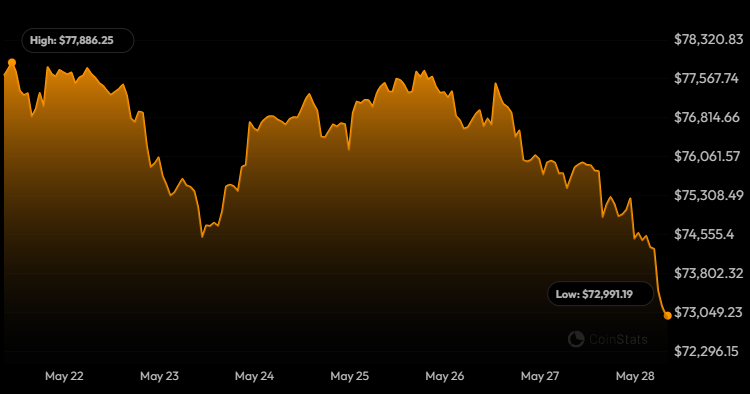
Source: CoinStats
Bitcoin has increasingly traded like a macro risk asset during geopolitical crises. When fear rises in traditional markets, crypto often reacts even faster because it trades 24/7 without market closures or circuit breakers.
Massive Liquidations Accelerate the Crash
The speed of the decline came largely from leverage unwinding.
Over $200 million in crypto positions were liquidated within 24 hours during the latest escalation, with the vast majority coming from long positions. Traders betting on upside momentum were caught offside as Bitcoin broke below key support zones.
As BTC lost the $75K level, forced selling accelerated across exchanges. Ethereum followed closely behind, falling under $2,000 for the first time since March.
The market structure had already become fragile before the geopolitical headlines arrived. ETF outflows, weaker spot demand, and elevated leverage created conditions where even one negative catalyst could trigger a liquidation cascade.
ETF Outflows Continue to Pressure Bitcoin
Institutional demand has also weakened significantly in recent weeks.
Spot Bitcoin ETFs have now seen billions in cumulative outflows over the past two weeks, signaling that large investors are reducing risk exposure rather than buying the dip.
Ethereum ETFs have also experienced persistent redemptions, extending one of the worst outflow streaks of the year. Analysts say this matters because ETF demand had become one of the market’s primary support pillars after the 2025 rally.
Without strong institutional inflows, Bitcoin becomes more vulnerable to macro shocks and leverage-driven volatility.
Why Ethereum Breaking Below $2K Matters
Ethereum falling under $2,000 is psychologically important because that level acted as major support throughout early 2026.
Santiment data shows retail traders immediately rushed to call the move a “buy the dip” opportunity. Historically, however, major bottoms tend to form only after optimism fully disappears and panic peaks.
Contrarian analysts warn that excessive dip-buying enthusiasm can actually delay a real bottom because it means sellers may not be exhausted yet.
At the same time, Ethereum’s long-term fundamentals remain intact. The CLARITY Act, ETF expansion, staking demand, and scaling upgrades are still bullish longer-term catalysts. But in the short term, sentiment and liquidity are driving price action far more than fundamentals.
All in all, the biggest variables remain geopolitical news and ETF flows. Any signs of de-escalation between the U.S. and Iran could trigger a sharp relief rally. But if oil prices continue climbing and institutional outflows persist, crypto markets may face more downside before a true bottom forms.
Read also:
Frequently Asked Questions
1. Why did Bitcoin and Ethereum crash today?
Bitcoin and Ethereum dropped due to escalating geopolitical tensions between the U.S. and Iran, including reported drone and missile strikes on a U.S. base in Bahrain. The selloff was amplified by over $200 million in crypto liquidations, ETF outflows, and fears that rising oil prices could delay Federal Reserve rate cuts.
2. Is this a good time to buy Bitcoin or Ethereum?
Some investors see the dip as a buying opportunity, but market sentiment remains fragile. Analysts warn that continued ETF outflows, geopolitical uncertainty, and weakening liquidity could push prices lower before a true bottom forms.
Related Articles
Cheeky Crypto says the panic over IOG dropping the Akropolis project misses the point. Cardano is streamlining to focus
Cheeky Crypto argues the elite use XRP as a velocity tool, not a moonshot. Near‑instant settlement creates an “infinite
Bittensor just shipped dynamic TAO. 67 subnets now compete for real-time emissions – dead subnets no longer earn like to
Chainlink CCIP pulled $4B from LayerZero in 60 days after a vulnerability disclosure. Kelp DAO moved $1.2B, Lombard $800